
Looking to get HD on your telly? We offer information on High Definition TV services available in the UK
 What is HDTV?
High Definition (HD) represents the latest in TV picture quality. HD offers a higher quality picture: more vibrant colours, greater detail and crisp picture clarity. You’ll also benefit from improved sound quality (5.1 surround sound).
How does it work? Well, a standard UK TV picture is made up of 576 horizontal lines of pixels, but a high-definition TV screen uses either 720 or 1080 lines (offering up to 4 times the number of pixels used to create a standard definition TV picture).
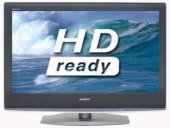
High Definition Digital LCD TV
HD in the UK
The BBC started trials of HD in May 2006. Now, a growing number of high-definition TV channels are coming on-stream, notably from Sky Digital. Sky currently leads the way in UK HD, offering over 50 channels of TV in stunning high definition.
As well as Sky’s HD service, High Definition is on offer from Virgin Media, Freesat and Freeview HD service. For a comparison, see our HD Providers list below, or our HD channel comparison chart.
What do I need to know about HD TV?
| Equipment |  To watch High-definition TV, you’ll need an “HD Ready” TV set. Even if you’re not planning to sign up to an HD service just yet, consider getting a TV with the “HD READY” logo To watch High-definition TV, you’ll need an “HD Ready” TV set. Even if you’re not planning to sign up to an HD service just yet, consider getting a TV with the “HD READY” logowhen buying a new TV.Your LCD, Plasma or DLP TV set will need to have a minimum resolution of 720 lines in wide aspect ratio. (More: HD Resolution) Your HD TV will need a different type of connector for connecting to an HD set-top box, Blu-ray player or games console – the connector will either be a DVI (Digital Video Interface) or more commonly, an HDMI (High Definition Multimedia Interface) connection. You’ll also need an HD TV decoder (such as a Sky+HD set-top box) to watch hi-definition TV.
|
| Digital Switchover | The UK’s analogue TV service was finally switched off in October 2012. You now need a digital TV receiver to continue getting telly.
It’s important to note that High Definition is nothing to do with the Digital Switchover. You don’t need an HD TV to get digital TV. |
| Programming | Programmes have to be recorded in the HDTV format, so that viewers can benefit from the improved experience of HD.
More and more content is now being recorded in an HD format, so we can expect the available content to increase over the coming months and years. |
How do I get HD programmes?
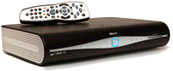
You need a digital TV service that supports HD, and an HD receiver. The HD receiver connects to your TV (normally using an HDMI cable). Here is a summary of the main HD TV services in the UK:
| Sky Digital | Sky Digital is currently leading the field in HDTV in the UK. Here are some facts:
|
| Virgin Media Cable | HD is being offered by cable TV firm Virgin Media. Originally under Telewest, the High Definition service launched in March 2006.
|
| Freesat |  Freesat launched in May 2008 and is operated by the BBC and ITV. It offers a range of free channels, plus HD content without a subscription. Freesat information Freesat launched in May 2008 and is operated by the BBC and ITV. It offers a range of free channels, plus HD content without a subscription. Freesat information
|
| YouView |  YouView launched in 2012 and combines Freeview and on-demand TV content. YouView launched in 2012 and combines Freeview and on-demand TV content.
You can get a free YouView box from BT, and get access to 4 Freeview HD channels, plus a decent collection of movies in HD to watch via Broadband on your TV. More details at get.youview.bt.com |
| Freeview | 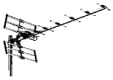 There will be four high-definition digital TV channels to be delivered via a TV aerial on Freeview by 2012. The service launched in parts of the UK on 2nd December 2009, and is now available across most of the UK. There will be four high-definition digital TV channels to be delivered via a TV aerial on Freeview by 2012. The service launched in parts of the UK on 2nd December 2009, and is now available across most of the UK.
More on Freeview HD. |

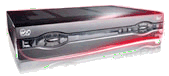
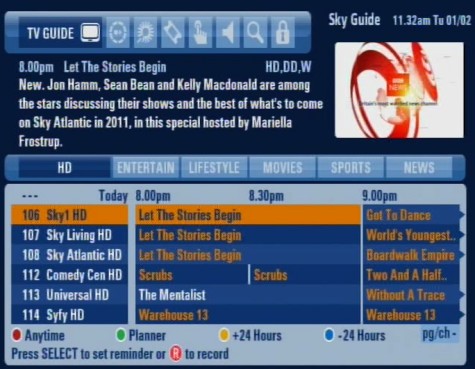
Sky’s Electronic Programme Guide showing HD content
HD FAQ
Here, we’ll try to answer your high-definition questions:
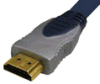
| HD connectors | The most common connector for High Definition equipment is the HDMI connector, pictured below.
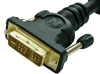
An alternative, is the slightly older DVI connector (Digital Visual Interface), pictured below:
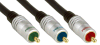
You also get high definition using component cables – note that this is analogue, and component does not carry the audio.
Looking for high-definition cables and adapters, such as HDMI leads, or HDMI to DVI cables? Try TV Cables or Maplin Electronics We recommend the Nikkai Pure range (high-quality, oxygen-free copper) for minimal signal loss. |
| 720 vs 1080 formats | High definition TV is transmitted in two different hi-def formats:
1080i offers more detail than 720p, but interlaced images aren’t as smooth as images that are rendered progressively. The format of an HD picture depends on how the programme maker recorded the programme. Set-top boxes such as the Sky+HD box support both 720p or 1080i HD formats, switching according to the programme’s format, and a high percentage of HD-Ready TV sets support 720p and 1080i (but check before you buy). The highest quality HD format is 1080p (progressive), and this is known as “Full HD” – However note that no UK broadcaster is currently offering 1080p content, so TV services don’t use this standard. For 1080p content, look at Blu-Ray discs or the output of some games consoles. |
| “HD Ready” | For a TV or HD product to be certified as “HD Ready”, it has to meet the following requirements:
|
| No HD TV yet? | About to get a Sky+HD box, Freeview HD Box or Virgin Media V+ box, but do not have an HD TV set yet?
Yes, you can use an HD set-top box even if you don’t yet have an HD-Ready TV set. Obviously, you won’t be able to watch HD content until you get an HD channel, but you will be able to watch the Standard Definition channels. Typically, you’ll connect from the HD box to the TV using a SCART lead. |
| TV aerial | Question from a site visitor: “Do I need a special aerial for LCD HD ready TV sets?”
If you’re looking to get HD via your TV aerial, you’ll need Freeview HD. If your aerial s able to let you receive Freeview channels, it should be fine for Freeview HD when it comes to your area. |
| Variable HD quality | Here’s a quality question from site visitor Peter Denton: “Please can you tell me why some programmes transmitted in HD are sometimes fantastic, and other times you would never know it was HD. Sky football matches are a good example…. sometimes great , other times not.”
Note that HD denotes the number of horizontal lines a picture has (minimum 720, compared with 576 for standard definition). Just because content is “in HD”, there’s no guarantee that it’s pin-sharp and perfect. A number of factors can affect HD quality:
|
| HDMI vs Component | You may find that your HD set-top box has both an HDMI socket and a set of Component sockets – but which is best?
Well, they both are capable of transmitting High Definition. HDMI is ‘digital’, so is less prone to interference over long distances. HDMI also carries the audio. Component is analogue and doesn’t carry audio. For more on this, read this article. |
| Not enough HDMI sockets? | 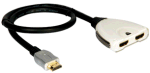 If your TV set doesn’t have enough HDMI sockets – you can get various adapters and switch boxes. If your TV set doesn’t have enough HDMI sockets – you can get various adapters and switch boxes.
At the basic end is a 2-into-one selector lead (the HDMI Selector from Maplin, and there are various other 2-way, 3-way and 4-way selectors available from TV Cables or Maplin Electronics. See our HDMI Help and Advice page for more. |
| Contrast ratio | When looking for a TV, you may see Contrast ratios quoted at you. The contrast ratio is the difference between black and white. Basically, the higher the ratio, the more difference between black and white the TV supports.
In Show 15 of our podcast, we heard from forum visitor Linus, who pointed out the following… “sales folk are keen to push ‘bigger is better’, but unless you watch your telly in a pitch-black room, you could be wasting your money going for big-number ratios. In a living room with moderate ambient light, anything higher than a 500:1 ratio wouldn’t be perceivable by the eye.” For more on choosing a telly, see our podcast’s How to choose a digital TV page, and listen to our audio guide in Show 25. |
| HD Media Player | 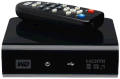 We can’t pass up the opportunity to mention the WD TV HD Media Player. A cheap and tiny box that plugs into your TV and lets you play back HD video on your telly (as well as photos and audio files). We can’t pass up the opportunity to mention the WD TV HD Media Player. A cheap and tiny box that plugs into your TV and lets you play back HD video on your telly (as well as photos and audio files).
Supports many different video, audio and image files and with two USB sockets for memory sticks and hard drives, this is a great and cheap option for watching HD content on your telly. See our full review, photos and screenshots on our WD TV HD Media Player Review. |
More questions?
Got a question about Hi Def TV in the UK, or have a comment on HD? Please post a message in our forum
Also, check out our online radio show for more on HD – High Definition featured in our Show 23 of FrequencyCast!

Hi Guys
Is the format of films recorded on my Grundig Freesat box compatible with PC. It will record and playback some although something has happened and it will not play all that is available on the recorded menu selection?
just wondering about this ultra hd definition like your adverts say I don’t know wat its like is this trial be open to the people spoke to sky whitch ive got I wasent impressed with 4g television so can you help