
On this page, we’ll look at RF modulators and how they can help to connect some types of digital TV equipment.
What is an RF modulator?
RF stands for “Radio Frequency”, but don’t let that scare you. Some TV equipment is capable of “modulating” its output, which in simple terms turns the output of that piece of equipment into a TV channel that a TV set or recorder can tune into.
Let’s take the example of a video recorder. Many recorders “modulate” their output, which means that if you connect a TV aerial from the video recorder, you can connect that aerial lead to the TV set, then “tune in” the TV set to the video recorder.
TV frequencies are in the range 21 to 68 UHF, and a modulated output can be set to one of these numbers.
Why would I want to use an RF modulator?
Two main reasons:
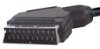 You want to connect a set-top box or recorder to a TV set that doesn’t have a SCART socket.
- You want to feed the output of a set-top box to another room in the house using aerial cable.
Where do I get an RF Modulator?
Some set-top boxes and recorders already contain an RF modulator (also known as a UHF modulator) – these include Sky boxes, BT Vision boxes (grey models only), Top Up TV boxes and many video recorders. If in doubt, check your equipment’s manual.
If your equipment doesn’t contain an RF modulator, you can buy a stand-alone RF modulator box, which connects to the equipment’s SCART socket.
You can buy an RF Modulator box from Maplin Electronics and from TVcables.co.uk
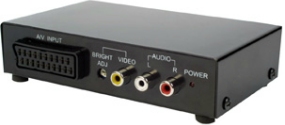
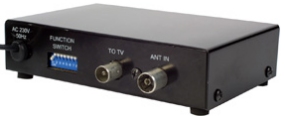
RF Modulator from Maplin Electronics (Front and Rear)
How do I use an RF Modulator
If your equipment has an RF modulator built-in, then you need to make sure it’s turned on (from the on-screen menu), and it’s programmed to a suitable channel number (the work on the standard TV 21 to 68 UHF channel numbers).
If you are using a stand-alone RF modulator box: into one end, you plug a SCART lead from your set-top box or recorder, and into the other end, you connect a standard co-ax aerial lead. You then need to set a channel number as per the supplied instructions.
Assuming that you have the RF modulator on and connected, connect using an aerial cable to the second TV, and then tune the second TV into the RF channel number that the modulator is set to (21 to 68 UHF) – You watch the output as if it were a TV channel
Alternatives
Many old video recorders have an RF modulator – you can use a video recorder as a “loopthrough” – connect your box to the input of a video recorder by SCART, tune the video in to the Line In / Aux, then connect the out of the video to the TV.
 Looking for a cheap Freeview box that works on a TV that doesn’t have a SCART socket? Consider the Icecrypt T5000 – a basic Freeview receiver box that has an RF-modulated output.

Is it possible to use two rf modulators on one aerial. I have two camera systems that I would like to feed to house televisions.
Best regards,
D. McWilliams.
hello. I have a problem/question I hope you can answer please. I have just bought a Sony smart TV and upgraded to sky HD box. As a result of this I have lost an aerial out socket. I have a multi connector in the loft to two other TV’s. I connected a simple splitter to the TV ariel input but I am now getting poor pictures on the connected TV’s. There doesn’t appear to be any connector on the Sky HD box for RF out.
Hi, I have a Samsung bluray player it has freeview. The problem is it has at the back only one hdmi, one usb and ariel in and out that’s it.
All senders are either scart or av. I tried to add a hdmi to av it wouldn’t work. Can anyone suggest how to solve?
Cheers
John
I have a virgin box and have fitted a Maplin RF modulator so that I can get sound/vision on the second TV (Sony) in the kitchen which only has a coax cable run to it. The picture and sound quality are fine except that the picture is clipped on each side, so for example when you are watching football the score does not appear in the corner of the screen which I find most annoying. Is there a cure for this or a different product I can use. the TV is about 5 years old so I cant see an issue with the set.
Maplin were not helpful.
andy parkin, try adjusting the display settings on your virgin box from the settings menu and you may be able to solve your problem
Hi
I’m considering moving from Sky to Virgin and want to do the same, i.e. watch the same channel in the kitchen, off the TV lounge. Happy watching the same channel. Did the advice re the screen work for you, as suggested?
Hi , I will try JD’s suggestion and let you know what the outcome is.
hi,i have a second tv connected with a modulator but i have to leave the main tv switched on in order to watch the 2nd.is there any way around this. thanks
Hello. My maplin RF modulator box has suddenly stopped working. No signal arriving at the TV at all from my virgin box. Tried going through the channels with the dip switches and none working. I haven’t changed anything and there is power to the box. Any thoughts?
How do I set up sky in a different room without Leeds