
Satellite TV FAQ – Answers to some common questions about satellite TV in the UK.
This page contains answers to general questions – for help on Freesat or Sky, try these links:
Installing and connecting a satellite dish
If you’re fairly ‘handy’, you can save yourself the cost of getting a satellite dish installed, and do-it-yourself.
 You can buy yourself a kit for less than £100 that comes with an 80cm satellite dish, digital TV receiver, and LNB – this will allow you to get the basic free-to-air channels with no subscription and no recurring fees. or, you can just buy the dish and connect to a Sky Digital or Freesat box. Take a look at maplin.co.uk for kits and dishes.
- To get Sky or Freesat channels, you’ll need to point a suitably-sized dish towards the Astra group of satellites positioned at 28.2º East above the Equator. From the UK, this will be a compass heading somewhere between 139 and 147 degrees (i.e. South- East) at an elevation of between 18 and 26 degrees. You need clear line-of-sight to the transmitter.
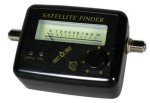
- Need help finding the satellite? You may need a satellite finder to locate the satellites.
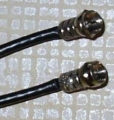
- Once in position, you need to run satellite co-ax cable from the LNB on the dish to your receiver. Cable and connectors are available from maplin.co.uk
- Then, connect the output of your satellite receiver to your TV, typically with a SCART lead
If you need more help, ask in our forum.
 Multiple outputs from one dish
A satellite dish can feed multiple satellite receivers. This is down to the LNB on the dish.
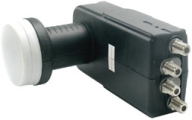
Pictured to the right is a Quad LNB – LNBs attach to your dish and receive the satellite signal. Typically, an LNB will have either 1, 2, 4 or 8 outputs – the one pictured has four, so can feed four satellite receivers. Each receiver will need to be connected to one of the LNB outputs via a separate co-ax cable feed.
Satellite receivers with a built-in hard disk are often “twin-tuner” devices – this means that they have two tuners. The Sky+ box is a good example of a twin-tuner satellite receiver.
 A twin-tuner box allows you to watch one satellite channel, while recording a different satellite channel. A box with two tuners will need two feeds connected to two LNB connectors.
If you want to feed extra boxes, or convert a single feed to two feeds (for a twin-tuner box), then you can either arrange for Sky’s engineers or a local satellite installer to do the work for you – or you can do it yourself. LNBs and cabling are available from Maplin.co.uk.
Two boxes from one dish
There are some situations where a user may want to have two satellite receivers connected to one dish. Commonly, this is so you can have one receiver in one room, and one in another, or if you have a Sky Digital box and also want a Freesat box.
There are several ways to achieve this, but they all involve complications.
For a start, it’s important to understand that a satellite receiver needs to take control of the LNB (the bit that sticks out from the dish), so that it can tune to the right frequency and polarity.
Two boxes can’t control the LNB at the same time, so you either need a switch box, or better still, to have a multi-LNB, with a separate cable running from the dish LNB to each receiver. Here are some notes on the subject:
Multiple feeds: Ideally, to connect multiple boxes to one dish, you’ll want to have a “Multi LNB” on your dish. Commonly, these can support 4 different feeds from one dish (for four tuners), or you can get an Octo LNB that supports 8 feeds. With a multi-LNB, you run one feed per tuner from the LNB to the receiver. Note that Sky+ and Sky+HD need two feeds from the LNB, as the boxes have two tuners.
Switch boxes: In some situations, you may find that the Maplin 2-way satellite switch (pictured here) may be of use.
Loopthrough: Some boxes, such as one or two of the Freesat boxes, have “loopthrough RF IN/Out sockets, to allow connection of a dish feed to a second box. There are some issues with this solution though – A satellite receiver needs to take control of the LNB (the bit of the dish that does the work), and it’s not possible for two receivers to control one dish LNB at the same time – one or other will have to control the voltage to the LNB, and the LNB polarity.
If you need more help on this subject, best to ask for help in our satellite TV forum
Problems with reception / picture quality?
See our Satellite TV Problems page for help and advice.
Satellite dish in conservation areas?
There are several places where it’s not practical or possible to have a satellite dish installed – one of the common ones being if you’re in a conservation area.
In this section, we look at some of the possible options available to you if you’re not able to have a standard dish installed on your property’s wall:
- Dish location: If you’re not allowed to have a dish attached to your wall, there are some other options – perhaps you’re able to attach a dish to a balcony, or attach a dish to a pole in the garden, or a fence? If in doubt, perhaps contact a local dish installer (from Yellow Pages) and see if they can find a way to install a dish for you.
- Dish camouflage: You may find this site of interest.
- Indoor dish: In most cases, this is not an option – as you need to have unobstructed line-of-site to Sky’s orbiting satellites at 28.2 degrees East. In some cases, you can point a dish out of a window to get a signal – Thanks to Duncan Hill for the following: “I have used an indoor dish, no more than 40cm and got perfect reception from Astra 2 (Sky/BBC), Astra 1, Hotbird and Hispasat. Even with curtains in the way. The only problems are on very rainy days. Locations tested: London and Brighton.”. Also, see a page of info at Satcure
- Loft dish: Very little chance of success. Signals do not travel well through slate or tile. If you have a loft window, or are prepared to replace some of your tiles either with thin perspex or microwave-transparent tiles, then there’s a chance of getting a signal
If you’re not able to get a dish installed where you live, you could consider other options such as Freeview, Cable or TV-over-Internet. See our Digital TV Options page for more.
If you’re able to get a satellite system installed elsewhere and you have broadband, you could also consider watching satellite on a PC over the Internet, using Slingbox
Communal satellite dishes
Both Sky Digital and Freesat receivers can work with communal satellite dishes.
Typically, a standard satellite dish can support up to four feeds. To do this, the dish is equipped with what’s called a multi-LNB (the box at the end of the arm). See our One Dish, two boxes FAQ for more on this.
Note: Sky+ and Sky+HD boxes have two tuners, so require two feeds from a dish, not one.
 Portable Satellite Dish?
Looking to watch free digital satellite TV out-and-about – perhaps from a caravan, or camp site?
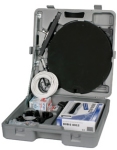
There are portable dishes available. Consider the Portable Satellite Camping System, from Maplin, which comes with dish and a basic receiver.
USB PC satellite receiver?
Can you get free-to-view satellite TV on a PC or laptop? If you have a spare USB 2.0 port on your computer, you should be able to connect a USB PC satellite TV receiver.
These are a little hard to come by, but the most common appears to be the Hauppauge WinTV-Nova-S USB. We’ve found this listed at: Play.com, Amazon and Dabs.com.
Got a question on Satellite TV? Ask in our Satellite forum |
Links
- Freesat – Information on the Free-to-view satellite service
- Sky Information – General information on Sky Digital
- Sky HD – High definition from Sky Digital
- Sky+ – Sky’s top- of- the-range digital recorder
- Sky Digital forum – Talk about Sky TV
- Sky Help – Advice and questions on Sky Digital
- SkyDigital undocumented – Secret keypresses and digibox information

Hi
I do B& B have a 12 or 15 yr old satelite dish. We have Sky sport and can only view tv through the dish. I now want to put tv’s in my guest rooms but need an Octo LNB so each room has its own freesat box. I have done one room, but can you advise which LNB is best for mhy dish and if I need an adaptor for the arm of any kind. thanks
Jo
The best way is to use “WiFi” LNBs, made near London, from the beginning of the 2000s. Or if you stick to the cable stuff use optical cable instead of the coaxial one. Beyond 70 m on the coaxial 50+% of the signal disappears, while to 1 sat. antenna 12.000 households can connect and only 0,03 Db disappears on a 1 km long cable. That sort of LNB is a little more costly than the “normal” ones, but even so affordable. As for the dividing of the signal, it is best to use a sort of a hub, which is able to copy 3 types of coding. It is made in Danemark in a family-managed fabric. About in 2010-2015 appeared the version 2 which is more for professional use. Which version are they selling now, I am not able to tell. You can see more about these on the website : http://www.TELE-audiovision.com The bimonthly magazine can be read as a PDF file, in 25 languages.
Hi,
I have a triple tuner with an internal hard drive. I have a DVB-S2, DVB-C, and DVB-T conection at the back of the box, would I need 3 feeds from the LNB of my satelite dish, to each of those conections to allow me to record 3 programmes at the same time
regards
Stephen
Hi what model is your tuner
I have 4 tvs in my pub that are fed a signal from the one sky sat and 1 sky plus box. What do I need to do to view say BBC 1 on one TV and say Channel 4 on another TV?
Ihave four feeds on my LNB which two do i need to connect for a recording freesat box.Thank you.
The Samsung tv i am thinking of buying has a built in FreesAt tuner and is wifi enabled. Provided I am using a satellite connection and my internet is up anD running-will I be able to access Freesat On Demand services as displayed on the regular Freesat EPG ?
We have a communal dish that only has one feed so could not use the recording features on sky so cancelled it. We previously had bt with two boxes .sky left me the boxes but as our tvs are already smart tvs they are pretty useless. We are considering buying 2 boxes one for each room but need to know what would be the best, and be able to use the multi recording features and pause tv etc. Can you point us in the right direction with this as I have noticed people selling these boxes have a disclaimer that once you set them up there is no return and I do not want to make an expensive mistake. Would be grateful poor any advice.
Lynda Willock
I have 2 sky Hd boxes. I received normal channels on my sky box, but my sky channels don’t work. I keep on getting no satelite signal when i select sky sports and my other sky channels which have included in my pack. Can anyone help regarding fixing this. Would be very gratefull with any advive.
Thanks Philip
Hi I am trying to connect seperate sky box in a different room and a freesat box i have connected coax cable to satellite dish run through wall into a splitter box then coax lead coming out the splitter box to sky box …..but still not working am I missing something?saying no satellite signal please help
Hello
I have one sky plus dish and want to run three separate sky plus HD decoders is this possible ?
Thanks
I have 3 tv’s running on 1 sky+hd box, 1 of which has a magic eye on it in the master bedroom, could I run a 4th tv with another magic eye
when our sky + HD box was fitted they only put in one feed from the dish, and programmed something in the box to let it know that. I want to add second feed now, so what I need to know is how do I program the box to know it has two feeds.
I have sky q at home .
I want to get a sky dish for my caravan and a cheap sky box like sky plus…
are the connections the same on boxes ??
I have seen different types of dishes the one I think I need is a zone 2 mark 4 this is compatible with sky q but not sure the sky plus box will fit …
If anybody can help???
Cheers